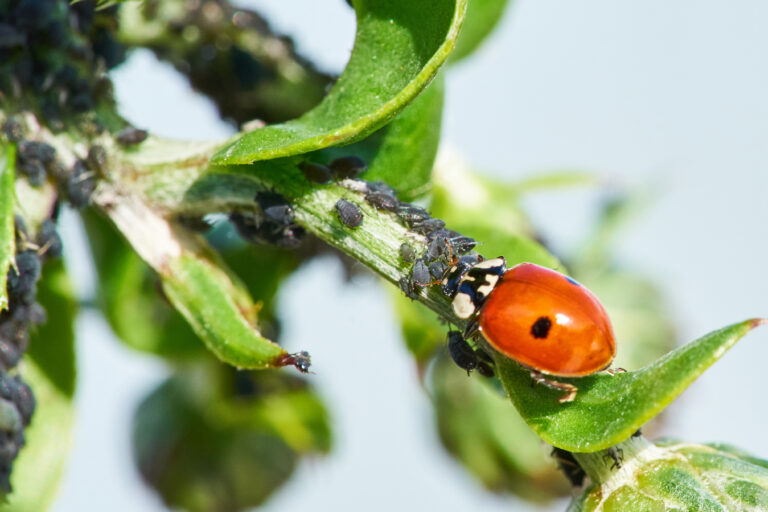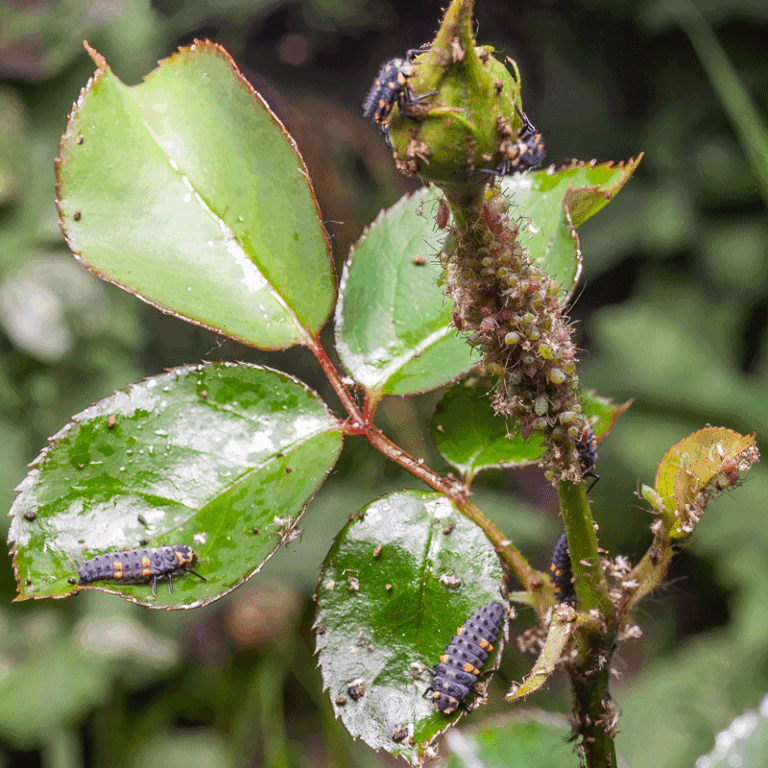
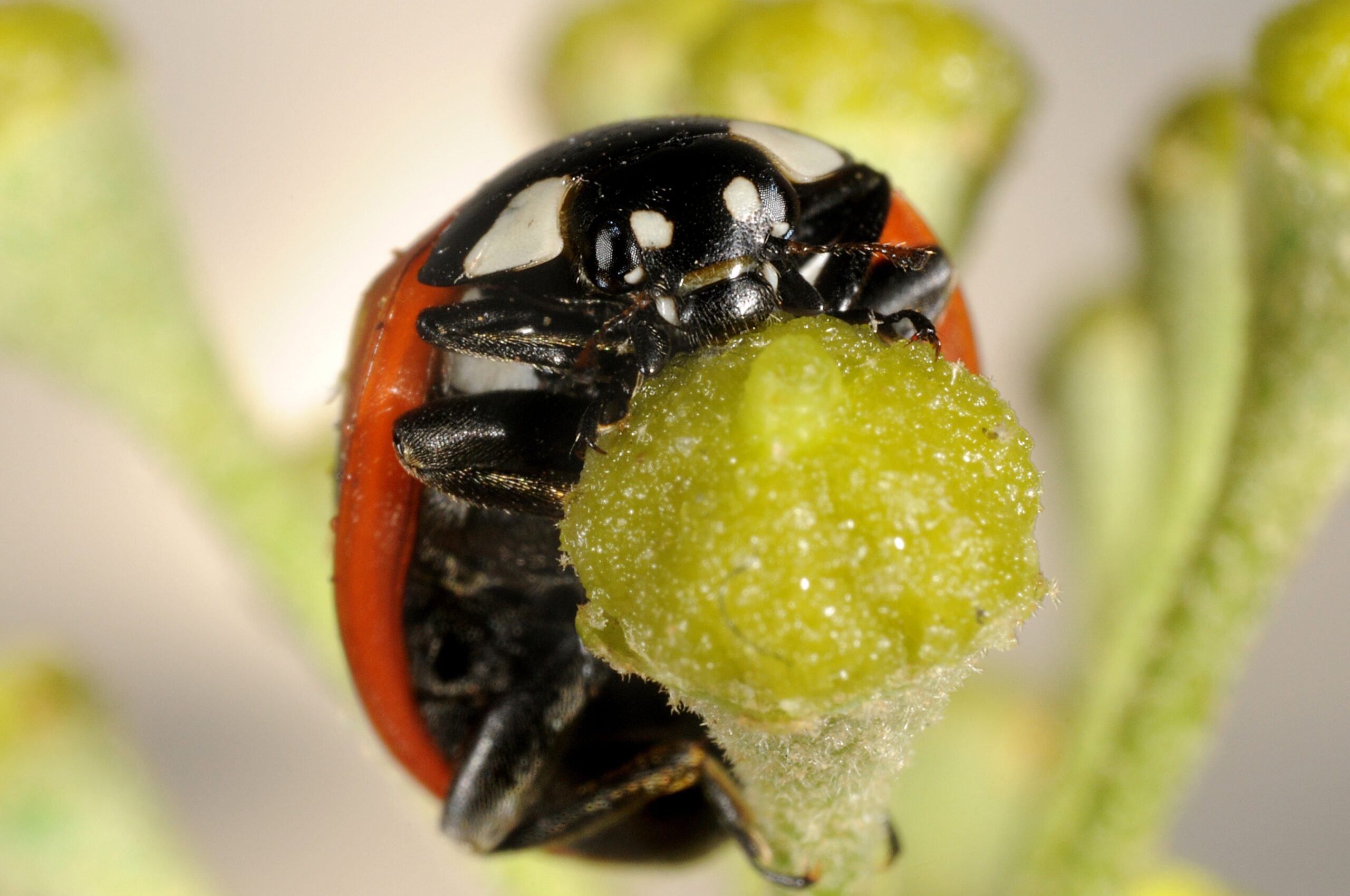
When you think of biological control of aphids, one image immediately springs to mind: the ladybug, a gardener’s long-time ally! But one question keeps coming up: should you buy larvae or adult ladybugs for maximum effectiveness?
The answer depends on your situation, your plants and the timing of the infestation. In this article, we help you understand the strengths and limitations of each option, so you can choose the best strategy for your crops.
Why use ladybugs to control aphids?
Aphids reproduce at dizzying speed. A single female can give birth to dozens of clones in just a few days. The result: your roses, vegetables and fruit trees can be invaded almost overnight.
In the face of this proliferation, ladybugs are formidable allies. Their appetite, particularly in the larval stage, enables them to quickly regulate colonies:
- an Adalia bipunctata ladybug larva can devour up to 150 aphids a day;
- an adult consumes an average of 100, while laying the eggs that will take over.
It’s this complementarity that makes them so strong. But which one should you choose, depending on your situation?
Ladybug larvae: gluttons that stay put
Larvae are often overlooked: their black, elongated appearance surprises gardeners accustomed to the pretty red and black carapace. Yet they are the most voracious of all.
Larvae advantages
- Maximum consumption: they eat relentlessly.
- Sedentary: unable to fly, they remain concentrated on your infested plants.
- Rapid impact: in just a few days, aphid numbers drop.
Larval limits
- They don’t lay eggs, so their action is limited to a few weeks.
- Their effectiveness depends on weather conditions: prolonged rain or cold can weaken them.
When to use larvae?
Use larvae when aphids are already present and well established on your plants. Their voracity and sedentary nature enable rapid, localized action on existing colonies.
Ladybug adults: insurance for the long term
The adults, recognizable by their red elytra punctuated with black, are the classic image of the ladybug. Less voracious than their larvae, they bring another strength: reproduction.
Adult assets
- Long duration of action: they settle in, lay eggs and ensure several generations.
- Dispersal capacity: they fly from one plant to another, covering a larger area.
- Preventive effect: by reproducing, they prevent new infestations from developing. Note, however, that you still need aphids for them to lay their eggs.
Limits
- They don’t clean as efficiently as larvae, as they disperse.
- Their mobility may cause them to leave your garden after a few days, especially if there are no aphids.
When to give priority to adults?
Use adults when the first aphids appear, or to cover a large area. Thanks to their ability to fly and reproduce, they provide extensive, long-lasting protection against emerging infestations.
Comparison: larvae or adults?
| Criteria | Ladybug larvae | Adult ladybugs |
|---|---|---|
| Appetite | Very high (up to 150/d) | Medium (approx. 100/d) |
| Mobility | Low (they stay put) | High (they fly and disperse) |
| Duration of action | Short (2 to 3 weeks) | Long-term (several egg-laying cycles) |
| Immediate effectiveness | Excellent | Average |
| Infestation prevention | Limited | Strong (thanks to reproduction) |
| Ideal for… | rapid, localized action on aphid outbreaks | dispersal and oviposition |
The winning strategy: combining larvae and adults
In many cases, the choice is not binary. Combining the two stages is the most effective solution:
- larvae for immediate impact on existing colonies,
- adults for lasting, preventive action on incipient outbreaks.
At Horpi, we often recommend this two-pronged approach, adapted to the size of your garden and the severity of the infestation.
Horpi expertise: efficiency guaranteed by science
Our breeding program for Adalia bipunctata ladybugs, a species endemic to Europe, enables us to supply both larvae and adults, selected for their robustness and efficiency. Every stage, from feeding to logistics, is scientifically controlled, to ensure that the auxiliaries arrive at your premises in the best possible conditions.
When you choose Horpi, you benefit from :
- advice tailored to your crops,
- insects bred with respect for biodiversity,
- a 100% natural solution, with no negative impact on your environment.
Conclusion: the right choice depends on your garden
If an aphid outbreak is already present on your plants and you need to act quickly, opt for larvae. If aphids are just beginning to appear, or you want to protect a large area over the long term, adults are your best ally.
And if you want optimum efficiency, the combination of larvae + adults remains the most effective strategy.
In any case, when you use Horpi ladybugs, you’re choosing an effective and environmentally friendly biological aphid control method!